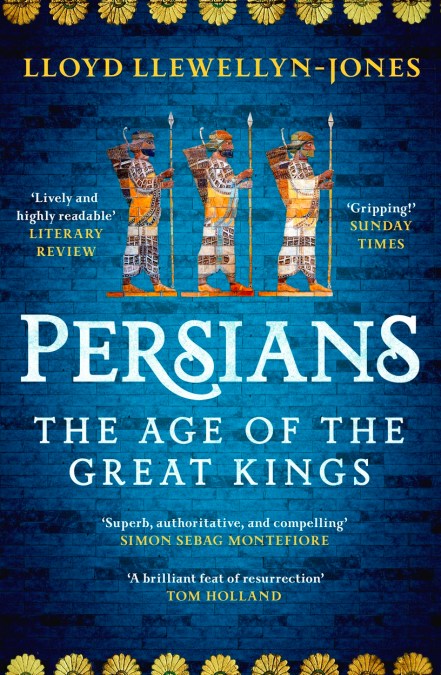
There's a lot to praise here. Firstly, the level of research and depth here is fantastic. It's clear Llewellyn-Jones did extensive work, especially in terms of finding authentic Persian sources from the Achaemenid period and squeezing every possible bit of information out of them. The narrative sections are also strong — Llewellyn-Jones's love for the Achaemenid period rulers shines through what could otherwise be relatively dull listing of rulers' names, achievements, and [presumed] causes of death. Additionally, the time spent on the impressive queen-mothers and women of the Achaemenid dynasty was greatly appreciated. I also loved the inclusion of linguistics as a part of the history here, and thought that Llewellyn-Jones did a great job of bringing in different domains (linguistics, theology etc) into his reconstruction of the history of the Achaemenid dynasty. As a survey of the Achaemenid dynasty, most of what a casual reader could want is here.
That being said, I have a lot of issues with this book. Firstly, the level of detail here is varied, but at its most granular this book is absurd. I struggled with the non-narrative section in particular, wherein the level of detail is excessive. Consider, for instance, the chapter "Constructing Majesty," wherein Llewellyn-Jones liberally quotes the dictates of the kings on their construction. Here, he explains in some detail the specific involvement of different regions of the empire in the construction, and how this represents the complexity of the governance etc. I expect the detail here is really excessive for most readers, and I was confused as to why it was present.
Additionally I had some gripes with the book's perception of itself as a response to the other histories of Persia. Llewellyn-Jones (accurately) criticizes much of the previous western scholarship on classical Persia and the Achaemenids. In particular, he contends that much of modern western classical history mischaracterizes the Achaemenids as barbaric despots, and that this is rooted in Greek histories' propagandization as well as the lack of preserved Persian sources. While I think these criticisms are accurate and have their place in the book, I found that they were too often repeated to the point that they lost any meaning or usefulness. I, while a casual fan of classical Greek history, did not view the Achaemenid empire as barbaric at all, and went into the book with little to no knowledge of the first Persian Empire. While I had read some excerpts of Herodotus, I was well aware that early historians, and Herodotus specifically, often embellished their histories with myth and unduly criticized geopolitical rivals with tall tales. In this context, I was glad to hear in the introduction that the book would focus more on Persian sources and refute these inaccurate stories of classical history.
What I was less pleased with was the omnipresence of this historiographical critique. It seemed that in nearly every chapter, there is some mention of the inaccuracy of the view that Persians were barbaric despots. I know that this view is wrong — I don't need to hear over and over that this view is wrong. The same goes for Herodotus. Due to the primarily oral tradition in the Achaemenid empire, as well as many texts being lost to time, a total avoidance of Greek histories of the period seems to have been impossible despite Llewellyn-Jones's intention. Due to this, Herodotus and others were often used where other sources did not exist. At every single mention of Herodotus, there was an accompanying explanation of the fact that his histories are unreliable, he embellishes, etc. I feel that any reasonable reader would be able to figure this out after the first mention, or at least the third, and by the second half of this book it became extremely frustrating to hear things amounting to: "Our only source on this incident is Herodotus. He is really unreliable, and his histories of the Persians… His account here could be Greek propaganda, or it could be true, [etc.]" Again, I do not dispute that Herodotus lacks modern historical rigor and his portrayal of the Persians and their customs is inaccurate. At the same time, hearing the same tired criticisms of him and the western classicists who drew on him really wore me down throughout this book.
These issues amount to a question about audience: who is supposed to read this? Llewellyn-Jones clearly has an interest in responding to the historical record and often employing every resource at his disposal to reconstruct every detail of the lives of common Persians, but surely he realizes that at least some readers have no interest in the minutia (particularly the minutia as reconstructed through architectural and scattered textual evidence) of Persian daily life. A pedestrian reader too probably isn't familiar with the literature on classical Persian history, and has no stake in the debate over Persian barbarism during the Achaemenid empire. Was the book then meant for academics? Unlikely. This is a mere 450-page survey of the Achaemenid empire, and it's unlikely that a scholar of classical history would seek it out. The audience for this is a mystery to me. I'm not sure who Llewellyn-Jones was writing for, or why he made the decisions he did about inclusions here.
One more gripe that may be specific to me:
I don't think enough time was spent on Alexander and the end of the Achaemenid dynasty. One thesis put forward by the book was the idea that Persia didn't follow a "rise and fall" structure familiar to western historians. While this is evidently true, and Llewellyn-Jones spent ample time demonstrating that the latter years of Persia were not characterized by a Gibbon-esque descent into decadence, I think his lack of time spent on the actual events of the fall of Persia was a miss. My understanding is that there are two primary reasons for this:
- Sufficient time has already been spent on Alexander and his conquests by other historians.
- The stories of the conquests of Alexander are so embellished by the Greek authors, most of whom wrote long after his time, that a non-mythologized reconstruction would be difficult.
While both of these hold water, I think that the lack of engagement with the last years of the Persian empire left the thread of "did Persia decline or fall suddenly?" feeling really incomplete. A more specific geopolitical study of why Alexander and the Macedonians were able to capitalize on Persian weakness to destroy the greatest and most powerful empire in the world was warranted and lacking. The story in this book is something like: "Darius III underestimated Alexander, who was very competent, and quickly lost ground." Shouldn't an empire with as complex a bureaucracy and as deep a military system as Persia be robust to invasions? Border conflicts, incursions, and rebellions were, as evidenced by much of this book, not new to Persia, so I'd love to hear a better story of why the Macedonian threat was so much more damaging to the empire than any previous one. I found the brevity of the final chapter quite frustrating.
While I spent a lot of this review criticizing Persians: The Age of the Great Kings, if someone asked me what I thought of the book I would simply say "It was great, really well researched." I think much of the work done in writing this was fantastic, and I would recommend it to anyone seeking a better understanding of the First Persian Empire.